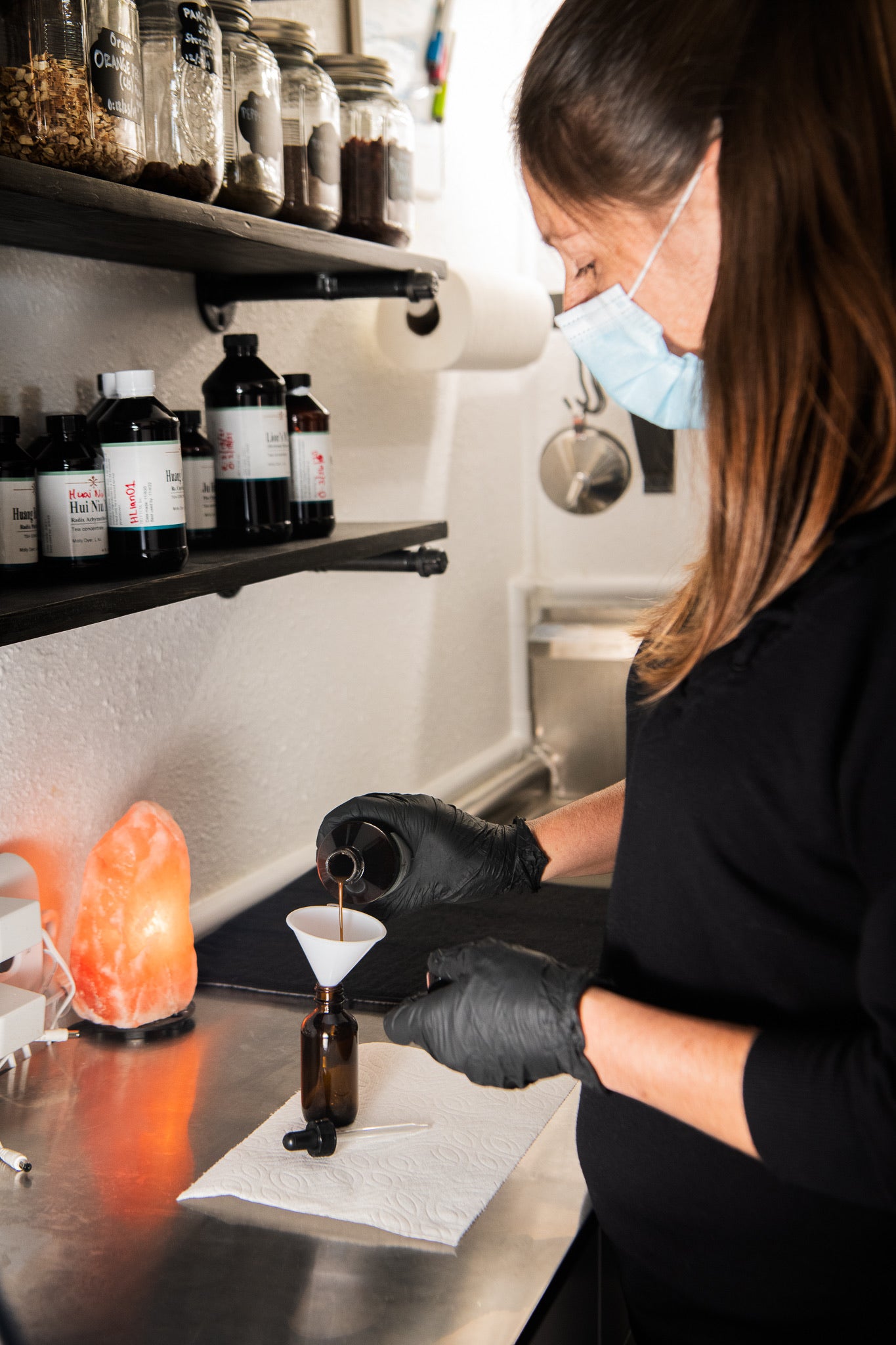

If you have struggled with eczema, tried every cream on the shelf, gone through rounds of antibiotics or steroids, and still found yourself back at square one, you are not alone, and you are not out of options.
Traditional Chinese Medicine (TCM) has been observing and supporting skin conditions for over 2,000 years. The earliest references to eczema appear in Chinese medical texts dating to 752 CE. This is not a new trend; it is a deeply developed system of understanding why the skin does what it does.
At The Herbal Skin Shop, every product we carry has been hand-selected by Molly Dyer, L.Ac., a Board-Certified Clinical Herbalist and licensed acupuncturist with advanced training in TCM dermatology. Below is a look at how TCM understands eczema, one of the most common and most frustrating skin conditions we see.
What Western Medicine Calls It
Eczema (atopic dermatitis) is a chronic inflammatory skin condition characterized by dry, itchy, red, or weeping skin. It is often managed with topical steroids, antihistamines, or immunosuppressants: treatments that can offer relief but do not always address why the flares keep coming back.
What TCM Sees
In Traditional Chinese Medicine, eczema is not one condition. It is a pattern of imbalance that shows up differently in different people. The most common patterns include the following:
Damp-Heat: Skin that is red, weeping, or oozing. There may be a sensation of heat or burning. This pattern is common in acute flares and is often linked to digestive imbalance or dietary factors. Other symptoms that may or may not present when Damp-Heat is present include:
- Yellow crusting
- Skin issues happening only in areas where the skin touches the skin, i.e. “intertriginous areas,” including the armpits, crooks of the elbows and behind the knees, medial thigh or groin, behind the ears and on the neck.
- Increased likelihood of sweating
- Increased thirst
- Thick coating on the tongue
- Dark urine or cloudy urine
- Abdominal pain, gas or bloating
- Tendency toward constipation or diarrhea
Blood Heat: Intensely itchy, inflamed skin, often worse at night or with heat exposure. This pattern is frequently seen in children and young adults. Other symptoms that may or may not present when Blood Heat is present include:
- Widespread redness
- Dry skin with a lot of scaling (flaking)
- Bloody scabs from scratching but not much crusting after itching other than that
- Itching that is worse at night and may disrupt sleep
- Red tongue; likely a darker red color
- Cold arms and legs or hands and feet
- Feeling hot at night, often with no sweating, but sometimes with profuse sweating
- Dark colored urine (dark yellow to orange)
- Restlessness or agitation, which may be worse in the evening or at night
- Constipation
- Thirst, which may be worse at night
Toxic Heat: Skin that is severely inflamed, hot to the touch, and intensely red, often with significant swelling. This pattern represents a more acute and intense presentation of heat in the body and may develop from untreated or worsening Damp-Heat or Blood Heat. It is sometimes seen in infected eczema or severe acute flares. Other symptoms that may or may not present when Toxic Heat is present include:
- Bright red, hot, and swollen skin
- Pustules or small pus-filled lesions on or near the affected area
- Skin that is painful rather than just itchy
- Fever or a general feeling of being unwell
- Swollen lymph nodes near the affected area
- Intense thirst, particularly for cold drinks
- Red tongue with a yellow coating
- Rapid pulse
- Restlessness or agitation
- Dark yellow urine
Blood Dryness and Deficiency: Skin that is chronically dry, thickened, or lichenified (leathery from repeated scratching). This is more common in long-standing eczema, especially in older adults. Other symptoms that may or may not present when Blood Dryness and Deficiency is present include:
- Skin that looks dull, gray, or lacks luster
- Scaling or flaking without much redness or heat
- Nails that are brittle, ridged, or pale
- Hair that is dry, brittle, or falling out more than usual
- Pale or slightly yellowish complexion
- Dizziness or lightheadedness, especially when standing up quickly
- Palpitations or a mild sensation of the heart fluttering
- Difficulty falling asleep or staying asleep
- Fatigue or a general feeling of being run down
- Pale tongue, sometimes with a thin dry coating
- Numbness or tingling in the hands or feet
Wind: Itching that moves or is unpredictable; here one day, different tomorrow. Wind patterns can be triggered by environmental changes, stress, or seasonal shifts. Other symptoms that may or may not present when Wind is present include:
- Itching that moves around the body rather than staying in one place
- Skin that flares suddenly and may resolve just as quickly
- Hives or welts that appear and disappear
- Symptoms that are worse in windy weather or with changes in season
- Sneezing, runny nose, or watery eyes alongside skin symptoms (Wind often affects multiple body systems at once)
- Sensitivity to drafts or air conditioning
- Itching that is triggered or worsened by emotional stress
- A tendency toward dryness in the skin, eyes, or throat alongside the itching
These patterns may occur on their own, or people may present with a combination of one or two of them. Identifying which pattern or patterns apply to you is key, and is exactly why a one-size-fits-all cream often falls short.
TCM also recognizes 11 distinct types of itch, each pointing to a different internal pattern. Those who have experienced severe skin irritation often understand this intuitively; they can describe different sensations, qualities, and triggers that set one episode of itching apart from another. Being able to identify your pattern is a meaningful first step: it can help you understand the underlying cause of your skin’s reactivity, and may support your efforts to address that imbalance through diet, lifestyle, topical care, or internal herbal support.
What This Means Practically
Two people with eczema may need completely different support depending on their pattern. Someone with weeping, hot, inflamed skin needs different herbal support than someone with dry, thickened, chronically itchy skin, even if both are labeled “eczema.”
This is the foundation of TCM dermatology: treat the pattern, not just the label.
How to Choose Products for Your Pattern
We cannot tell you which of our products is right for you without seeing your skin in person. What we can do is provide detailed descriptions on every product page that explain which TCM patterns each formula is designed to address, so you can read through and make a more informed choice based on the pattern descriptions above. If you recognize your skin in one of the patterns described here, look for those same pattern names in our product descriptions.
For a truly personalized recommendation, we invite you to book a clinical consultation with Molly at Light & Dark Acupuncture & Apothecary in Aurora, CO.
Why Topical Herbal Products Work Differently
Most commercial skincare targets the surface of the skin: killing bacteria, unclogging pores, reducing oil, or suppressing inflammation directly at the site. These approaches can be helpful, and we do not dismiss them.
But TCM topicals are formulated with a different goal in mind: to work with the skin’s patterns rather than just suppressing what is visible. Herbs traditionally used to clear Damp-Heat, cool Blood Heat, or resolve stagnation have been refined over centuries of clinical use, and modern research is beginning to explore why many of them work at a physiological level.
How We Choose Our Products
The products carried at The Herbal Skin Shop are hand-selected by Molly Dyer, L.Ac., a Board-Certified Clinical Herbalist with advanced training in TCM dermatology. Every product in the shop has been chosen with one question in mind: is this the best available option for my clients’ skin?
Our herbal topicals are sourced from a small number of trusted formularies with deep roots in clinical TCM dermatology, including Dermatology M, founded by Mazin Al-Khafaji, one of the world’s leading TCM dermatologists. His formulations are developed with potency and clinical efficacy as the primary concern: these are not general wellness products, but clinical-grade herbal preparations refined through decades of advanced dermatology practice.
We also carry honey and bone broth sourced from trusted local Colorado producers, chosen for their quality and their role in supporting skin health and overall wellness from the inside out.
Everything in this shop reflects the same standard we apply in the clinic: careful selection, clinical reasoning, and a commitment to carrying only what we would recommend to our own patients.
A Note on Expectations
This page is educational and is not a substitute for clinical care. If you have moderate to severe eczema, especially if it is affecting your quality of life, your sleep, or your child’s wellbeing, we strongly encourage you to work with a qualified TCM dermatology practitioner who can assess your full pattern and provide internal herbal support alongside topicals.
Not local to Aurora or Denver? You can find a qualified TCM dermatology practitioner through the International Traditional Chinese Medicine Dermatology Association (ITCMDA) at itcmda.com.
Some of Our Most Used Eczema Products
- Nourishing Cream (Zi Cao Shui Gao) — suitable for all patterns; a deeply moisturizing daily cream
- Soothing Cream (Shi Zhen Shui Gao) — Blood Heat, Blood Dryness and Deficiency, Wind
- Soothing Cream #2 (Ma Chi Xian Shui Gao) — suitable for all patterns; lightweight and colorless
- Solution EC: Damp Heat Herbal Soak — Damp-Heat; particularly helpful for weeping or acute flares
- Indigo Ointment (Qing Dai Gao) — Toxic Heat
- Nourishing Ointment (Run Ji Gao) — suitable for all patterns; particularly well suited to Blood Heat, Blood Dryness and Deficiency, and Wind
- Licorice Cream (Gan Cao Shui Gao) — Blood Dryness and Deficiency, Wind
- Soothing Bath & Shower Oil (Shu Min Mu You Yu) — suitable for all patterns; a gentle soap-free wash for sensitive skin
The Herbal Skin Shop is an online apothecary curated by Molly Dyer, L.Ac., Board-Certified Clinical Herbalist and licensed acupuncturist. Products are selected for educational and general wellness purposes and are not intended to diagnose, treat, cure, or prevent any disease.